The crest on Plate 5, Image 1 (Pl. 5. cr. 1. or Pl. 5. 1.) is described as a demi-lion rampant, holding in his dexter (right) paw a mullet (star) or an etoile (wavy star).
Surenames: 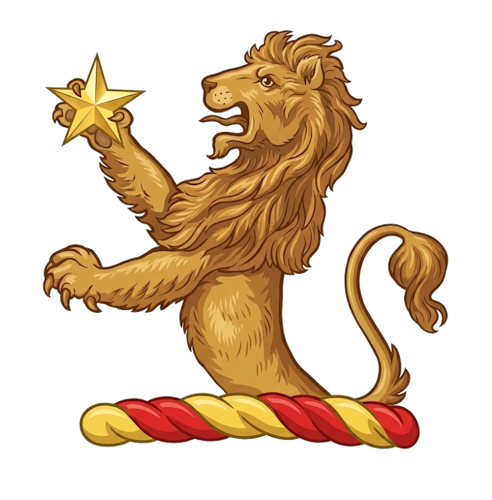
- Clandinen
- Cock (London)
- Craig
- Dillon (England)
- Elstob (England)
- Gledhill (England)
- Glethill (England)
- Henlock (England)
- Holborn (Menne)
- Inglis (Advocate; Cramond; Edinburgh)
- Lamb (England)
- Lambe (Brocket-hall, Hertfordshire)
- Lamm (England)
- Liddell (Scotland)
- Liddiard (Rockley, Wiltshire)
- Lyz (England)
- Roberts (London; England)
- Stable (England)
- Starr (England)
- Tooker (England)
- Warmouth (Newcastle, Northumberland)
- Wilan (Kingston-Upon-Hull)
- Willan (London)
- William (London)
Symbolism of the Crest
-
Demi-Lion: The lion is the king of beasts, and even in its “demi” (half) form, it is a timeless emblem of dauntless courage, strength, and majesty. It represents a warrior who is fierce in the face of enemies and magnanimous to those who yield.
-
Mullet (Star): The mullet (often depicted as a five-pointed star or spur-rowel) symbolizes divine quality from above and is often associated with eminence in learning or virtue. It indicates a person of noble aspiration who shines with merit and seeks guidance from higher powers.
General Symbolic Meanings The combination of the lion and the star suggests a balance between physical might and spiritual or intellectual guidance. It implies a lineage or individual that possesses the strength to defend their principles (the lion) while being guided by a higher purpose, truth, or clarity of vision (the star).