The crest on Plate 3, Image 7 (Pl. 3. cr. 7.) is described as an unicorn’s head (often noted as couped, erased, or issuing from a wreath).
Surnames Associated with this Crest: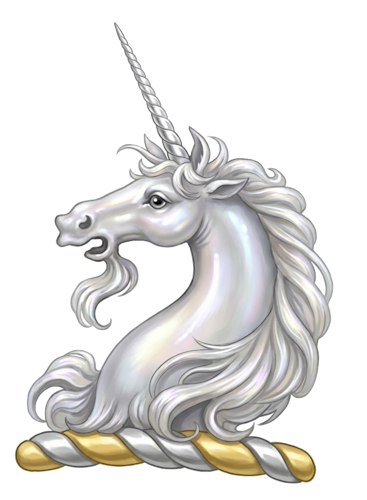
- Leaknor (Sussex)
- Leigh (Egginton, Derbyshire)
- Lewknor (Worcestershire)
- Man (Scotland)
- Nagle (England)
- Pery
- Peterkin (Scotland)
- Piller (England)
- Piper (England)
- Poulett (England)
- Ramsay (Barnton, Scotland)
- Ritchie (Glasgow, Scotland)
- Sherborne (Stanghurst, Lancashire)
- Sherborne (Ribleton, Lancashire)
- Shirborne (Stanyhurst, Lancashire)
- Sladden (England)
- Stewart (Innermeath, Scotland)
- Stewart (Ochiltree, Scotland)
- Stewart (Ardsheall, Scotland)
- Stewart (East Indies, Scotland)
- Stewart (Appin, Scotland)
Symbolism of the Crest Unicorn: The unicorn is a legendary creature that serves as a powerful symbol of purity, virtue, and strength. In heraldry, it represents a warrior who would rather die than be captured, symbolizing an untamable spirit. Because the unicorn was believed to be a wild beast that could only be tamed by a virgin, it is also strongly associated with innocence and Christ. The horn of the unicorn was historically reputed to have the power to neutralize poison, adding a layer of symbolism regarding healing and protection.
General Symbolic Meanings The unicorn’s head specifically focuses the symbolism on the creature’s intellect and spirit. It suggests a lineage that values extreme courage combined with virtue. The bearer of this crest is often seen as a defender of the truth and a protector against malevolence, embodying the combination of physical power and spiritual purity.