The image corresponds to Plate 2, Crest 6 (A sword in pale) or (A dagger in pale). Both represent a weapon held upright.
Surnames: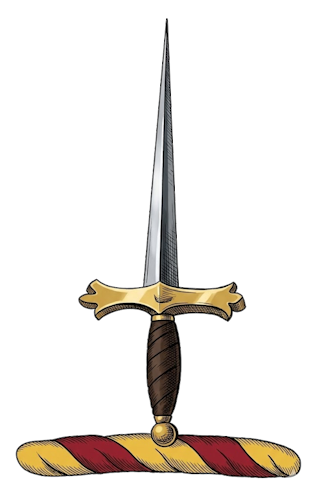
- Aberkerdour (Scotland)
- Aberkerdor (Scotland)
- Barclay (Pearston, Scotland)
- Blan (Scotland)
- Blane (Blanefield, Scotland)
- Blean (Scotland)
- Cazenove (England)
- Dalziel (Earl of Carnwath)
- Damer (England)
- Dymock (Lincolnshire)
- Gowan (Scotland)
- Osburne (Peppermill)
- Poyntz (England)
- Roundell (Hutton Wansley, Yorkshire)
- Scobie (England)
- Toding (Scotland)
- Todrig (Scotland)
- Vintris (England)
- Borston (England)
- Buchanan (Auchleshie)
- Cairncross (Balmashannon)
- Coytmore (England)
- Dalzell (England)
- Durnford (England)
- Macjuire (Ireland)
- M’Quire (England)
- Pring (England)
- Thetford (England)
- Winbolt (England)
Symbolism of the Crest Sword / Dagger: In heraldry, the sword is a weapon that symbolizes justice and military honor. It represents the power to wage war and the authority to administer justice. When depicted “in pale” (vertical), it signifies a readiness to serve and a stance of defense. Erect Position: The upright position of the weapon emphasizes vigilance and action, suggesting a family that is always prepared to defend its rights and principles. Gold Hilt (Pommel and Crossguard): The specific coloring of a steel blade with a gold hilt often denotes purity of purpose backed by generosity and elevation of mind.
General Symbolic Meanings The solitary sword is a potent symbol of executive power and righteous authority. Unlike a sword held in a hand (which emphasizes the act of wielding power), the standalone sword often represents the abstract concept of justice or the state of being prepared for conflict. It suggests a lineage that values honor, maintains a strong defensive posture, and upholds the law.