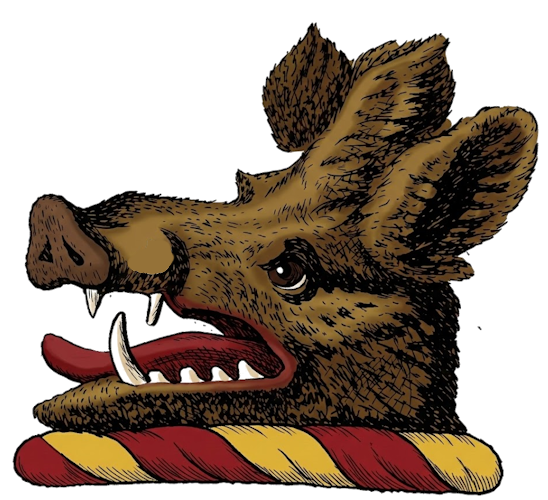
The crest on Plate 2, Image 5 (Pl. 2. cr. 5.) is described as a boar’s head couped (cut smoothly at the neck), though some variations describe it as erased or include specific colors and charges.
Surnames:
- Adams (London, England)
- Asheton (Cheshire, England)
- Asheton (Lancashire, England)
- Aston (Cheshire, England)
- Asshetton (Scotland)
- Assheton (England)
- Baillie (Hoperig, Scotland)
- Bairnsfather (Scotland)
- Baker (England)
- Barnbe (Barton, Lancashire)
- Bassel (Warwickshire, England)
- Brodley (London, England)
- Brodley (Lancashire, England)
- Brokesby (Melton-Mowbray, Leicestershire)
- Campbell (Duke of Argyle, Scotland)
- Campbell (Ashnish, Scotland)
- Campbell (Earl of Islay, Scotland)
- Champayn (Shapwick)
- Cruickshank (Amsterdam, Netherlands)
- Cruickshanks (Scotland)
- Cunningham (Baushan, Scotland)
- Downing (England)
- Eel (England)
- Fouks (England)
- French (Scotland)
- Gordon (England)
- Gordon (Clunie, Scotland)
- Gough (Somersetshire, England)
- Grobham (Great Wishford, Wiltshire) [
- Haliday (Tillibote, Scotland)
- Halliday (Tullybole, Scotland)
- Hallyday (Scotland) [
- Humphress (England)
- Innes (Innes, Scotland)
- Kercy (England)
- Knaplock (Winchester, England)
- Lawless (Scotland)
- Lychfield (Shropshire, England)
- M’Liver (Ashnish, Scotland) [
- Rodney (Devonshire, England)
- Seaton (Tough, Scotland)
- Seton (Touch, Scotland)
- Seton (Culbeg, Scotland)
- Sheils (Scotland)
- Swineen (Staffordshire, England)
- Swineen (Sutton Chenell, Leicestershire)
- Stewart (Scotston, Scotland)
- Tallerton (England)
- Tarley (England)
- Tasker (England)
- Thimbleby (Irnham, Lincolnshire)
- Thin (Scotland)
- Torley (England)
- Tyzard (England)
- Urquhart (Newhall, Scotland)
- Vaughan (Dudleston, Shropshire)
- Vennor (England)
- Warcop (Silverdale, Yorkshire)
- Warcupp (Cumberland, England)
- Warcupp (English, Oxfordshire)
- Warcupp (Northmore, Oxfordshire)
- Williams (England)
- Winstanton (England)
- Wrotesley (England)
- Wynn (Duddleston, Shropshire)
Symbolism of the Crest
Boar’s Head: The boar is a classic heraldic symbol of courage and fierceness in battle. It represents a warrior who would rather die than flee, as the boar is known to fight to the death. In Scottish heraldry, the boar’s head is often associated with hospitality (as it was the head of the feast) or with the defeat of a dangerous enemy/outlaw. Couped: This term signifies that the head is cut cleanly in a straight line, distinguishing it from “erased” (which would look torn). This serves as a mark of difference between branches of families but generally retains the primary symbolism of the animal itself.
General Symbolic Meaning
The boar’s head is one of the most prominent symbols in British and Scottish heraldry, particularly among the Campbell, Gordon, and Swinton clans. It suggests a lineage with a history of bold military service and unflinching bravery. When associated with the mottoes found in this list (such as “Ne obliviscaris” – Do not forget), it implies a deep respect for ancestry and a warning to enemies that the bearer is as dangerous when provoked as the wild boar.