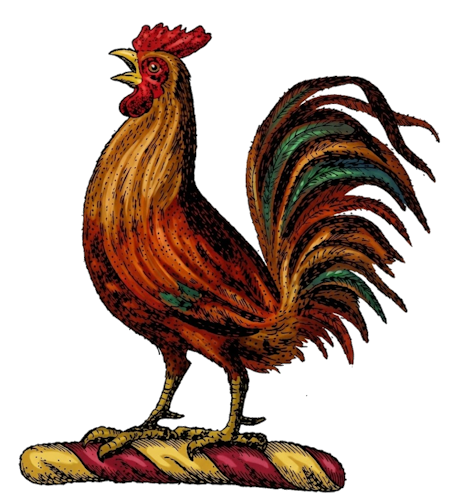
The crest on Plate 2, Crest 11 (Pl. 2. cr. 11.) is described as a cock (or rooster), often depicted crowing, standing, or walking.
Surnames Associated with this Crest:
- Actimson (Scotland)
- Aind (Scotland)
- Airth (Scotland)
- Aitchison (Rochecitoch)
- Aitkenson (Scotland)
- Alcock (Sivertost, Northamptonshire)
- Alcock (England)
- Alexander (England)
- Alicock (Northamptonshire)
- Alkenhead (England)
- Allen (England)
- Allicock (England)
- Allicocke (England)
- Altkemion (England)
- Ard (England)
- Atchison (Scotland)
- Atchison (England)
- Atkinson (Scotland)
- Beltufo (England)
- Blackiston (London)
- Blackston (England)
- Blackstone (Durham)
- Blakston (England)
- Blukiston (London)
- Boles (Suffolk)
- Bols (England)
- Brown (Edinburgh)
- Burgon (England)
- Coars (Shropshire)
- Coats (Yorkshire)
- Cobum (Scotland)
- Cock (Scotland)
- Cockburn (England)
- Cockburn (Lanton)
- Cockburn (Ormiston)
- Cockbume (Scotland)
- Cockridge (England)
- Coles (Buckinghamshire)
- Coles (Leicestershire)
- Cookcworthy (England)
- Corrie (Edinburgh)
- Coxson (Yorkshire)
- Crow (Caermarthenshire)
- Currie (Edinburgh)
- Cusne (England)
- Dewar (Lassode)
- Dounie (Scotland)
- Downfield (England)
- Downie (Scotland)
- Ducarell (Lambeth, Surrey)
- Dush (England)
- Eldecur (England)
- Ellercur (England)
- Emmerson (England)
- Forbes (Craigivar)
- Grant (Auchnanie)
- Grave
- Grubbham
- Guion (England)
- Guyon (England)
- Hancock (England)
- Hellier (England)
- Helyard (England)
- Hilliard (Durham)
- Hilliard (Yorkshire)
- Hillyard (Yorkshire)
- Holden (Scotland)
- Hyldyard (England)
- Ingram (Essex)
- Ingram (Herefordshire)
- Ingram (London)
- Ingram (Viscount Irvine)
- Ingram (Warwickshire)
- Ingram (Worcestershire)
- Ingram (Yorkshire)
- Johnson (London)
- Johnson (Yorkshire)
- Kay (Dorsetshire)
- Kognose (England)
- Landle (Scotland)
- Langley (Lancashire)
- Langley (Suffolk)
- Langley (Yorkshire)
- Law (Lord Ellenborough)
- Law (Lawbridge)
- Laws (Scotland)
- Lee (Middlesex)
- Lodwich (England)
- Lyle (Scotland)
- M’Worth (England)
- Mackworth (Glamorganshire)
- Mathieson (Scotland)
- Nowlan (England)
- Ormstone (Scotland)
- Perin (England)
- Rig (Tegsland)
- Rigg (England)
- Rigg (Downfield, Scotland)
- Rocheford (England)
- Rowdon (England)
- Simond (London)
- Slaten (England)
- Standish (Berkshire)
- Standish (Lancashire)
- Standish (Leicestershire)
- Stephens (Waterford)
- Tamworth (Lincolnshire)
- Tamworth (London)
- Tharpe (London)
- Thorpe (Northampton)
- Thring (England)
- Tosh (Scotland)
- Tunstall (Durham)
- Tunstall (England)
- Tunstall (Yorkshire)
- Vavasor (Yorkshire)
- Vavasour (Lincolnshire)
- Vavasour (Northamptonshire)
- Vavasour (Yorkshire)
- Williams (Hertfordshire)
- Williams (Middlesex)
- Wykes (England)
Symbolism of the Crest
Cock / Rooster: The cock is a widely recognized heraldic symbol of vigilance, courage, and virility. Known as the “Herald of the Morning,” it represents watchfulness and a readiness to greet the dawn or face danger. When depicted crowing or with wings flapping, it emphasizes a readiness for battle and an eagerness to defend one’s territory. In many instances, it is also considered a bird of light, symbolizing the triumph of light over darkness or good over evil.
General Symbolic Meanings
The image of the rooster generally implies a lineage or individual characterized by boldness and alertness. It suggests a family that values bravery in conflict and diligence in peace. Often associated with heroes, the cock signifies a person who is always prepared and will not be taken by surprise, embodying the motto often associated with it: “Vigilans et Audax” (Vigilant and Bold).