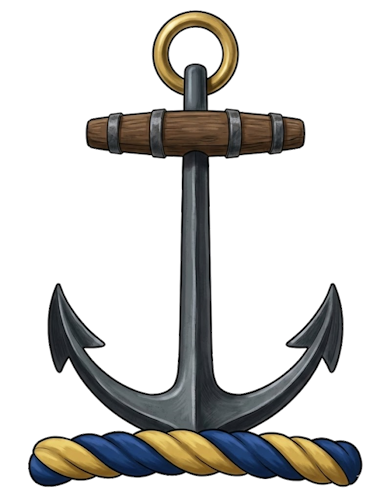
The crest on Plate 7, Image 2 (Pl. 7. cr. 2.) is described as an anchor in pale, sometimes cabled (with a rope), proper.
Surnames:
- Allaway (England)
- Alloway (England)
- Brages (London)
- Bruges (London)
- Brunton (England)
- Catesnelboge (England)
- Coats (Glasgow)
- Crack (Edinburgh)
- Edinburgh (City of) (Scotland)
- Gillespie (Newton)
- Gray (Scotland)
- Grieve (Edinburgh)
- Groet (Scotland)
- Hepburn (Keith)
- Hitching (England)
- Kinnear (Edinburgh)
- Longland’s (Scotland)
- Ormistone (Kelso)
- Pitcairn (Pitlour)
- Rait (Halgreen)
- Roberton (Earnock)
- Roberton (Bedlay)
- Smith (Glasswall)
- Smith (Camno)
- Smith (Gothenburg)
- Spence (Shetland)
- Stainforth (England)
- Steedman (Scotland)
Symbolism of the Crest Anchor: The anchor is a preeminent symbol of hope, steadfastness, and security. In a spiritual context, it represents salvation and a firm faith that holds steady during the storms of life. In a secular or heraldic sense, it often denotes naval service, maritime trade, or a family that remains stable and grounded. When depicted cabled (with a rope), it emphasizes the strength of the bond holding the vessel or family secure.
General Symbolic Meanings The anchor serves as a powerful reminder to hold fast to one’s values, faith, or duties during turbulent times. It suggests a person or lineage that is reliable, composed, and perhaps has a history of succoring others or navigating difficult waters, whether literal (seafaring) or metaphorical (overcoming adversity).