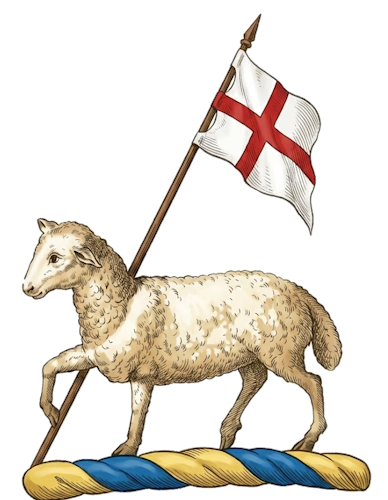
The crest on Plate 9, Crest 10 (Pl. 9. cr. 10.) is described as a Holy Lamb (or Paschal Lamb), often regardant (looking back), supporting or carrying a flag (banner or standard) over the dexter shoulder, frequently charged with a cross (St. George’s or St. Andrew’s).
- Beawfice (England)
- Boggie (England)
- Bogie (England)
- Crosby (Scotland)
- Crossby (Scotland)
- Davie (Scotland)
- Dewar (Alnwick)
- Dowdall (Ireland)
- Hickey (Ireland)
- Lamb (Scotland)
- Langholme (England)
- Lluellin (Hertfordshire)
- Malmains (England)
- Mills (London)
- Parry (England)
- Pascol (England)
- Richards (Rew, Devonshire)
- Rowe (Lamerton, Devonshire)
- Stopford (Ireland)
- Wastfield (Wiltshire)
- Wastfield (Somersetshire)
- Wastfield (London)
Symbolism of the Crest
Paschal Lamb / Holy Lamb (Agnus Dei): The lamb is the pre-eminent symbol of innocence, gentleness, purity, and patience under suffering. When depicted as the “Paschal Lamb” or “Agnus Dei,” carrying a flag or banner (often charged with a cross), it signifies faith, victory over death, and the triumph of the spirit. Flag/Banner: The banner represents spiritual warfare and the rallying point of faith, indicating that the bearer is a soldier of Christ or holds deep religious convictions. Halo (Glory): Often associated with this figure, the halo (or glory) emphasizes sanctity and divine favor.
General Symbolic Meaning
The combination of the lamb and the military standard suggests a duality of nature: a gentle, peace-loving disposition paired with a steadfast readiness to defend one’s faith or principles. It implies a lineage that values purity of heart but possesses the courage to stand firm for a cause.