The crest on Plate 9, Image 7 (Pl. 9. cr. 7.) is described as 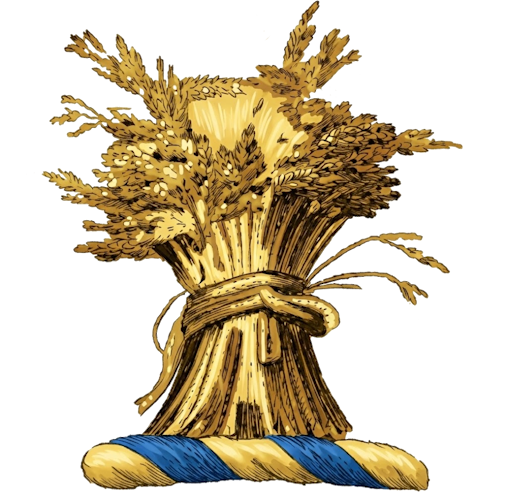
Surnames:
- Alvas (Scotland)
- Alves (Scotland)
- Aust (England)
- Barney (Norfolk)
- Barns (Glasgow)
- Baron (Bradwell, Essex)
- Baron (Skirnby, Essex)
- Baskerville (Herefordshire)
- Berney (Norfolk)
- Blair (Lethenty)
- Blair (Scotland)
- Blaquiere (England)
- Blaquire (Ireland)
- Bouling (England)
- Burket (England)
- Burkett (England)
- Catcher (England)
- Cheap (Mawhill)
- Cheap (Rossie)
- Cheap (Wellfield)
- Cheap (Pusk)
- Crawford (Cloverhill)
- Cumine (Scotland)
- Cuming (Coulter)
- Cummin (Scotland)
- Darby (Suffolk)
- Dolman (Spaw, Berkshire)
- Donald (Conheath)
- Donaldson (Scotland)
- Ducket (London)
- Ducket (Wiltshire)
- Ellis (England)
- Falknor (England)
- Ferrier (Edinburgh)
- Foller (Northiam, England)
- Folvill (Cheshire)
- Fovell (Cheshire)
- Girle (England)
- Goldie (Craigmure)
- Goldie (Scotland)
- Golding (Suffolk)
- Golding (Essex)
- Goudie (Scotland)
- Gouldie (Scotland)
- Gregorie (Lenton, Nottinghamshire)
- Grenvile (Stow, Buckinghamshire)
- Grenvile (Watton, Underwood, Buckinghamshire)
- Grenville (Lord Grenville)
- Grenville (Lord Glastonbury)
- Gwatkin (England)
- Hesketh (Rufford, Bart. Lancashire)
- Hesketh (England)
- Heskett (England)
- Hiders (England)
- James (Kent)
- James (Essex)
- Kelso (Kelsoland)
- Lawson (Cairnmuir)
- Leke (England)
- M’Laws (Garden)
- Maltby (Maltby, Cleveland, Yorkshire)
- Merefield (London)
- Michael (England)
- Miln (England)
- Milnes (Scotland)
- Modyford (Middlesex)
- Oatly (England)
- Ottley (Pichford, Shropshire)
- Paul (Norfolk)
- Paxton (Scotland)
- Peterborough (England)
- Platt (England)
- Randoll (England)
- Reath (Edmiston, Scotland)
- Reede (England)
- Reid (Ireland) [Sheaf of Rye]
- Roby (England)
- Routledge (England)
- Rowan (Scotland)
- Rowand (Bellyhouston, Ireland)
- Scambler (Kichling, Norfolk)
- Sicklemore (Ipswich, Suffolk)
- Skeen (Dyce, Scotland)
- Spilsbury (England)
- Spurwaye (Dartmouth, Devonshire)
- Spyer (Oxford)
- Spyre (England)
- Stevenson (Cumberland)
- Stevynson (Lincolnshire)
- Stevynson (Weston, Derbyshire)
- Temple (Marquis, Buckingham)
- Tippet (England)
- Vallance (Scotland)
- Vanderplank (England)
- Warnford (Stanbridge, Hampshire)
- Waruford (Venhampton, Wiltshire)
- Watur (England)
- Wauchope (Niddrie, Bart. Scotland)
- Wauchope (Elmiston, Scotland)
- Whitefoord (Scotland)
- Whitworth (Adbaston, Stafford)
- Widnell (England)
- Winton (Scotland)
- Youl (Scotland)
Symbolism of the Crest Garb (Wheat Sheaf): The Garb is a heraldic term for a sheaf of grain, usually wheat, though sometimes oats or rye. It is a symbol of plenty, abundance, and a bountiful harvest. It signifies the rewards of patient labor, the fertility of the land, and the sustenance of life. The binding around the sheaf represents unity and the gathering together of resources or family strength. In specific instances, like the Baskerville family, it appears as a sheaf of rosemary, symbolizing remembrance.
General Symbolic Meaning The use of the Garb in a crest typically points to a family with historical ties to the land, agriculture, or land ownership. It stands as a peaceful emblem, contrasting with the weapons and predatory animals often found in heraldry. It suggests a lineage that values industry, cultivation, and the prosperity that comes from diligent effort. It is an optimistic symbol, often associated with mottos regarding “increasing” or “flourishing,” representing a hope for the continued growth and stability of the family line.