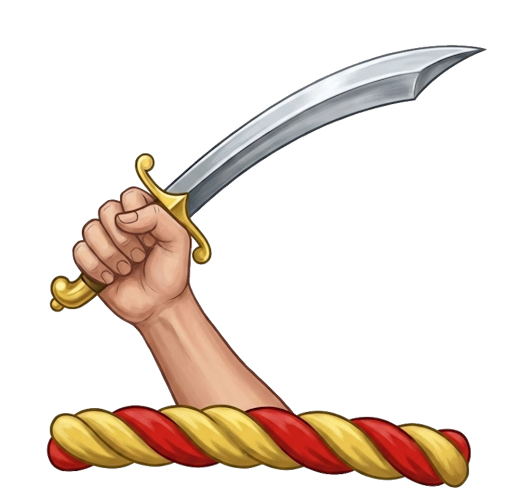
The crest on Plate 4, Crest 1 (Pl. 4. cr. 1.) is described as a dexter hand (or arm) brandishing or holding a scymitar, cutlass, sabre, or couteau sword.
Surnames Associated with this Crest:
- Adderton (England)
- Aderton (England)
- Affleck (Scotland)
- Ainsle (England)
- Balmanno (Scotland)
- Blackwood (Scotland)
- Boswell (Scotland)
- Brice (England)
- Brice (Antrim, Ireland)
- Browes (England)
- Bruce (Scotland)
- Bryce (England)
- Buchanan (Scotland)
- Cobb (England)
- Cobbe (England)
- Couper (Scotland)
- Cowper (Gloucestershire)
- Dalziel (England)
- Damerney (England)
- Darmant (England)
- Demeschines (England)
- Dowgiss (Scotland)
- Dowglass (Scotland)
- Elliot (Scotland)
- Ewat (Scotland)
- Finlay (Scotland)
- Foreman (Scotland)
- Forman (Scotland)
- Fry (Dorsetshire, England)
- Garrard (England)
- Gordon (Scotland)
- Heart (Scotland)
- Heeley (England)
- Heely (England)
- Inglis (England)
- Joliffe (England)
- Kragg (England)
- Lamford (England)
- Lancaster (England)
- M’Aulay (Scotland)
- M’Haddo (Scotland)
- M’Kay (Scotland)
- M’Taggart (Scotland)
- Macrae (Scotland)
- Masterton (Scotland)
- Matheson (Scotland)
- Meschines, De (England)
- Mowbray, De (England)
- Napier (England)
- Napier (Scotland)
- Niblie (Scotland)
- Nock (England)
- Officer (Scotland)
- Ogilvie (Scotland)
- Parker (England)
- Peachey (England)
- Peterson (England)
- Pim (Ireland)
- Readers (England)
- Sawers (Scotland)
- Seaton (England) [
- Seton (England)
- Shortreed (Scotland)
- Stewart (Scotland)
- Stuart (Scotland)
- Vile (England)
- Walmsley (England)
- Weeks (England)
- Wemyss (England)
Symbolism of the Crest
Dexter Hand / Arm: The hand is a symbol of the pledge of faith, sincerity, and justice. The right hand (dexter) specifically indicates a pledge of trust and protection. Scymitar / Cutlass / Sabre / Falchion: These curved blades are distinct from the standard knightly sword. They are emblems of military honor and execution of justice, but historically, the scimitar specifically often denoted participation in the Crusades or Eastern campaigns. The cutlass may suggest naval service or maritime defense. Being “brandished” or held aloft signifies a readiness for action and defense.
General Symbolic Meaning
The combination of a strong hand brandishing a curved blade represents a lineage prepared to defend its rights and honor at a moment’s notice. It suggests a history of active military service, particularly where agility and close-quarters combat were required, or potentially a connection to historical naval prowess. The imagery conveys a “word and deed” philosophy—the hand represents the pledge, and the sword represents the means to enforce or defend that pledge.