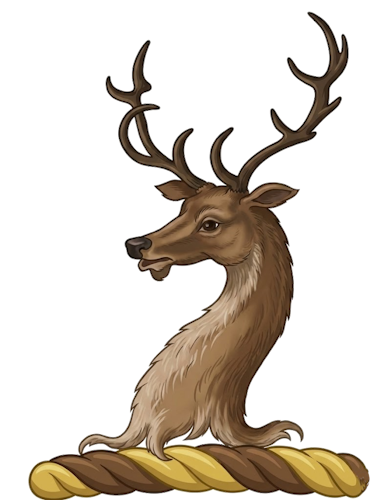
The crest on Plate 6, Image 6 (Pl. 6. cr. 6.) is described as a stag’s head (or buck’s, hart’s, or deer’s head), usually erased (jagged edge at the neck), and sometimes attired (horned) or charged with various symbols like crescents or fleurs-de-lis.
Surnames Associated with this Crest:
- Andrew (Blackhoulds)
- Andrew (Devonshire)
- Andrewes (Suffolk)
- Andrews (Bishop of Winchester)
- Anbie (England)
- Astry (England)
- Belasin (Lord Wortabye)
- Bell (Jamaica)
- Bellingham (Ireland)
- Broadley (England)
- Brockdon (Brockdone, Devonshire)
- Budorside (Cornwall)
- Budoxhed (Badick, Cornwall)
- Bulworth (England)
- Burleigh (England)
- Calvil (Scotland)
- Cahun (Scotland)
- Cam (England)
- Carr (Ettol, Bart.)
- Carre (Scotland)
- Chelitor (Butterly, Durham)
- Cheytor (England)
- Colquhoun (Kentulor)
- Colquhoun (Kilmardony)
- Connell (Ashtown)
- Court (England)
- Couts (Scotland)
- Creketot (England)
- Dick (Braid, Bart.)
- Dirom (Crichie)
- Dixie (Wyrmondham, Norfolk)
- Edington (Glasgow)
- Egerton (England)
- Finlason (Scotland)
- Forbes (Bully-how)
- Forster (Etherstone)
- Fouler (Scotland)
- Fraser (Fingask)
- Fraser (Auchnagarn)
- Fraser (Scotland)
- Fraser (London)
- Fraser (Leanciune)
- Fraser (East India Company, Scotland)
- Fraser (Eskdale)
- Frazer (Lord Lovat)
- Frazer (Scotland)
- Frewke (England)
- Frisel (Scotland)
- George (Scotland)
- Goff (Ireland)
- Golte (England)
- Goostrey (Buckinghamshire)
- Gordon (Tarquhoun)
- Green (Barnet, Hertfordshire)
- Green (Bristol)
- Green (Oxfordshire)
- Green (Norfolk)
- Green (Wilby)
- Green (Essex)
- Gunter (Chichester)
- Gunter (Emly, Sussex)
- Hanning (England)
- Hartgull (England)
- Hemenhall (England)
- Hengscot (England)
- Hoad (Edmonton, Middlesex)
- Hoad (London)
- Hoare (Middlesex)
- Hume (Scotland)
- Hutchison (Scotland)
- Karr (England)
- Kein (Lord Jedburgh)
- Ker (Cevers)
- Ker (Scotland, Northampton)
- Ker (East India Company)
- Ker (London)
- Knightley (England)
- Lea (England)
- Lister (Fitchworth, Sussex)
- Lister (London)
- Lister (Mydhoppe, Yorkshire)
- Lister (Derbyshire)
- Lister (Rowton, Shropshire)
- Little (Scotland)
- Lloyd (Whitenester, Gloucestershire)
- Lloyd (Cheame, Surrey)
- Lytle (Bart of Ayot, England)
- Macadam (Scotland)
- McDougal (England)
- McGuire (England)
- McLeay (Scotland)
- M’Phaill (Scotland)
- Mason (England)
- Maxwell (Earl of Farnham)
- Maxwell (Bart of Nether Polloc)
- Maxwell (Scotland)
- Mortymer (England)
- Nel (Attleborough, Norfolk)
- Norcliffe (England)
- Ord (England)
- Peele (England)
- Pevelesdon (England)
- Plowden (England)
- Popham (Willington, Somersetshire)
- Popham (Huntworthy, Somersetshire)
- Potkin (Cambridge)
- Potkin (Seven Oaks, Kent)
- Potkin (Richmansworth, Hertfordshire)
- Raikes (England)
- Raynlsford (England
- Raynold (England)
- Read (England)
- Ridgley (Longdon, Staffordshire)
- Ridgley (Abright Hussey, Shropshire)
- Rogand (England)
- Riggeley (Staffordshire)
- Rigmaiden (Wadaker, Lancashire)
- Rigmayden (England)
- Roe (Higham Hill, Essex)
- Roe (Moswell Hill, Middlesex)
- Romayne (England)
- Rone (Langford, Shropshire)
- Ronne (Hounslow, Middlesex)
- Row (Devonshire)
- Sage (England)
- Scot (Hanwood)
- Semple (Cathcart, Renfrewshire)
- Simmons (England)
- Skene (England)
- Smith (Mitcham, Surrey)
- Spence (Lathallan)
- Spence (Edinburgh)
- Spens (Lathallan)
- Spens (Midlen)
- Standley (England)
- Stanley (Skotore, Norfolk)
- Thriepland (Fingask, Bart.)
- Wackett (England)
- Walker (England)
- Whiteley (Shropshire)
- Windsor (Lord Windsor)
- Wiley (Shropshire)
- Woodhead (England)
- Wright (St Edmund’s Bury, Suffolk)
- Wright (Aldington, Kent)
- Wybrants (England)
- Wylde (Worcestershire)
- Yles (Scotland)
- Young (Scotland)
Symbolism of the Crest
Stag / Buck / Hart: The stag is a widely recognized symbol of purity, solitary life, and fleetness. It is often considered the most prudent and sagacious of beasts, symbolizing one who is politic and a lover of harmony. In heraldry, the stag represents one who will not fight unless provoked, but when cornered, will fight to the bitter end. Erased: This term describes a head or limb that appears torn off with jagged edges, rather than cut cleanly (couped). It typically signifies a violent and honorable history, suggesting the ancestor may have been a warrior or attained the crest through a feat of strength.
General Symbolic Meanings
This crest generally symbolizes a lineage connected to the nobility of the hunt or the stewardship of the land. It suggests a family characteristic of alertness and agility, combined with a peaceful nature that transforms into formidable resolve when the family’s honor or safety is threatened.